

How Do You Balance Durability and Design in Wall-to-Wall Carpet Selection for Hotel Areas
2026-10-19
Wall-to-Wall Carpet Selection for Hotel Areas is one of the most consequential decisions a hospitality design team will make, because the floor must survive years of rolling luggage, housekeeping traffic, and spilled coffee while still looking refined. At LUCK, we have supplied flooring for hotels across different tiers, and the lesson is consistent: durability and design are not opposites—they are two outputs of the same specification process. This guide explains how to balance them with concrete criteria, comparison tables, and answers to the questions hoteliers ask most often.
Start With Performance Criteria, Not Color
Design decisions made before performance thresholds are set almost always get reversed. Build the specification around four measurable pillars:
-
Traffic classification – EN 1307 class 32/33 for guest rooms and corridors, class 33 for lobbies.
-
Pile weight and density – 900–1,200 g/m² for guest rooms; 1,200–1,500 g/m² for public areas.
-
Fibre choice – nylon 6 or nylon 6,6 for resilience; wool blends for premium suites; solution-dyed polypropylene for budget back-of-house.
-
Backing system – impervious backing in F&B and spa zones to resist moisture.
Once these numbers are locked, the design team can explore pattern and color inside a performance envelope rather than retrofitting performance into a beautiful but unsuitable product.
The Durability vs. Design Trade-Off Matrix
| Hotel Area | Durability Priority | Design Priority | Recommended Construction | LUCK Solution Focus |
|---|---|---|---|---|
| Guest rooms | Medium | High | 900–1,100 g/m² nylon cut pile | Soft hand-feel, custom colourways |
| Corridors | High | Medium | 1,200 g/m² loop pile, class 33 | Patterned to hide soiling |
| Lobby | Very high | Very high | 1,300–1,500 g/m² dense loop | Bespoke luxury patterns |
| Restaurant / bar | High | High | Solution-dyed nylon, stain treatment | Dark bases, tight texture |
| Spa / poolside | Very high (moisture) | Medium | Impervious backing, low pile | Anti-slip, mould-resistant |
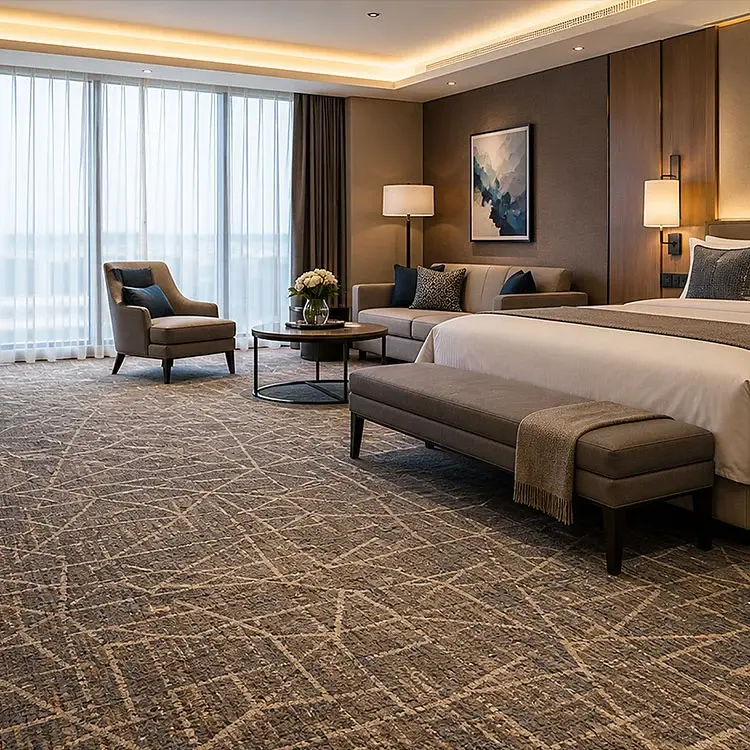
The pattern column matters more than most specifiers expect: a well-designed multi-tone or linear pattern can mask footprints and vacuum marks, effectively extending perceived durability without adding weight.
Design Levers That Do Not Compromise Performance
-
Use pattern instead of colour depth to hide soiling—mid-tone geometrics outperform solid dark shades.
-
Specify solution-dyed yarns where colour fastness to cleaning agents is critical.
-
Choose low-contrast borders in corridors; high-contrast borders show edge wear first.
-
Coordinate with lighting—warm 2700–3000K lighting flatters wool and nylon blends and reduces the need for heavier face weights.
-
Pilot-test the sample under real cleaning chemicals before approving the design.
FAQ: Wall-to-Wall Carpet Selection for Hotel Areas
Q: How do you balance durability and design in Wall-to-Wall Carpet Selection for Hotel Areas?
A: Set performance thresholds first—traffic class, pile weight, fibre, and backing—then select pattern and colour within that envelope. Specify patterned loop pile for corridors to hide soiling, denser cut pile for guest rooms to preserve comfort, and always pilot-test samples against your actual cleaning chemicals. LUCK provides matched performance and design data sheets for every collection so the two are evaluated together, not sequentially.
Q: What pile weight is recommended for Wall-to-Wall Carpet Selection for Hotel Areas with heavy traffic?
A: For lobbies and corridors, specify 1,200–1,500 g/m² with a dense loop construction and class 33 rating. Guest rooms can use 900–1,100 g/m². Density matters more than weight alone—a tightly tufted 1,100 g/m² carpet can outperform a loose 1,400 g/m² product. LUCK technical sheets list tuft density alongside pile weight so specifiers compare like with like.
Q: How does Wall-to-Wall Carpet Selection for Hotel Areas affect maintenance cost and lifespan?
A: Fibre type, backing, and pattern jointly determine cleaning frequency and replacement cycles. Solution-dyed nylon with impervious backing typically reduces deep-clean frequency, while patterned designs mask interim soiling between scheduled cleans. A properly specified carpet in a mid-scale hotel commonly achieves 7–10 years in guest rooms and 5–7 years in public areas. LUCK offers lifecycle cost modelling to support budget approval.
Bringing It Together
Balance is achieved through sequence: performance criteria first, design exploration second, pilot testing third. Hotels that follow this order report fewer mid-life replacements and stronger guest feedback on comfort and quietness. LUCK supports each stage with sample libraries, technical documentation, and custom colour development for Wall-to-Wall Carpet Selection for Hotel Areas.
Contact us today to request samples, performance data sheets, or a lifecycle cost assessment for your next hotel project—our team will help you specify flooring that performs as beautifully as it looks.