

How Do Lacquer Wardrobes Combine Luxury, Durability, and Practical Storage?
2026-08-25
Article Summary: Lacquer wardrobes have become an attractive choice for modern bedrooms, walk-in closets, villas, apartments, hotels, and high-end residential projects because they combine a refined surface appearance with highly configurable storage. However, achieving a premium result requires more than selecting a glossy color. Substrate stability, coating consistency, door weight, hardware, dimensional accuracy, packaging, and installation planning all influence the final performance of a lacquer wardrobe. This guide explains the key considerations behind a well-designed lacquer wardrobe and shows how VSME approaches customization, manufacturing precision, and project delivery.
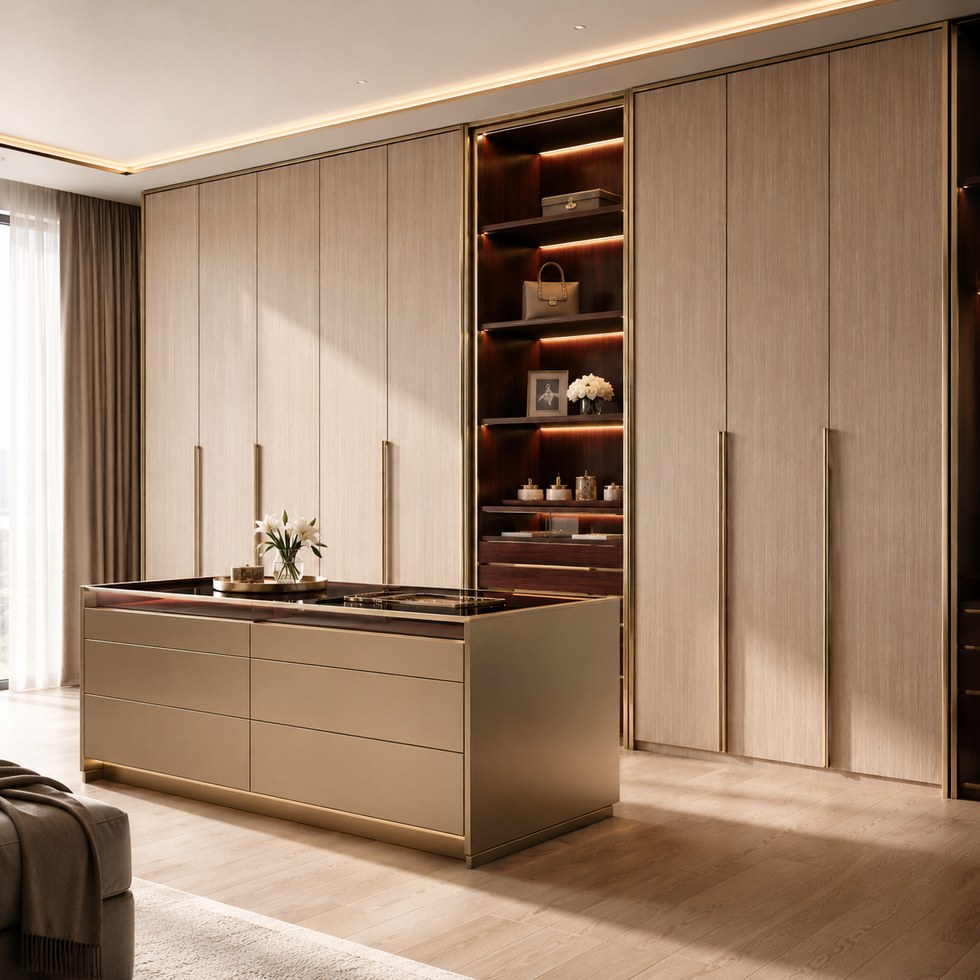
Table of Contents
- What Makes Lacquer Wardrobes Different?
- How Does the Lacquer Finish Affect Appearance?
- How Should the Cabinet Structure Be Selected?
- How Can Lacquer Wardrobes Improve Storage Efficiency?
- How Does Customization Solve Project-Specific Problems?
- How Is Manufacturing Precision Maintained?
- How Do Hardware and Door Construction Affect Performance?
- How Can Lacquer Wardrobes Be Protected During Shipping?
- How Should Buyers Evaluate a Lacquer Wardrobe Supplier?
- Key Lacquer Wardrobe Considerations
- How Can Lacquer Wardrobes Be Maintained?
- Frequently Asked Questions
- Conclusion
What Makes Lacquer Wardrobes Different?
A wardrobe is no longer simply a place to hang clothes. In contemporary residential interiors, it often becomes an important architectural element that influences the visual character, storage efficiency, and daily convenience of an entire bedroom or dressing area.
Lacquer wardrobes are particularly suitable for projects that require a clean, refined, and highly coordinated appearance. Their smooth finished surfaces can create either a subtle contemporary atmosphere or a dramatic luxury statement, depending on the selected color, sheen, hardware, lighting, and surrounding materials.
One of the biggest advantages of lacquer is design flexibility. A project can use restrained neutral tones for a minimalist bedroom, darker finishes for a sophisticated dressing room, or carefully selected colors to coordinate wardrobes with kitchen cabinets, wall panels, doors, or bathroom furniture.
However, a beautiful sample does not automatically guarantee a successful finished installation. Large wardrobe doors can magnify manufacturing inconsistencies. Uneven color, poor substrate preparation, unstable panels, weak hinges, inaccurate drilling, or inadequate shipping protection can turn an attractive design into a costly project problem.
For this reason, purchasing decisions should consider the complete product system rather than focusing only on surface appearance.
How Does the Lacquer Finish Affect Appearance?
The finish is one of the first characteristics people notice when evaluating lacquer wardrobes. Because wardrobe doors often occupy a large visual area, small surface imperfections can become much more obvious under natural daylight or directional lighting.
Two common approaches are matte and high-gloss lacquer finishes.
- Matte finishes: Provide a softer visual effect, reduce strong reflections, and work particularly well with minimalist and contemporary interiors.
- High-gloss finishes: Create stronger reflections and a polished appearance that can make a room feel more luxurious and visually expansive.
- Custom colors: Allow wardrobes to coordinate with architectural finishes, furniture, flooring, and other built-in cabinetry.
Surface consistency is particularly important on large doors. If different panels have visibly different tones or gloss levels, the entire installation may appear inconsistent even when each individual component looks acceptable.
VSME addresses this challenge through controlled coating processes and digital color management. According to its product information, the company uses automated coating equipment, digital color matching, and spectrophotometry to control batch-to-batch color differences. Its lacquer wardrobe solutions include both low-reflectivity matte surfaces and high-gloss finishes.
A properly controlled multi-layer coating process can also help create a smoother visual surface and reduce problems such as uneven texture and the orange-peel appearance that may occur when coating conditions are poorly controlled.
How Should the Cabinet Structure Be Selected?
The visible lacquer surface is only one part of a wardrobe. The substrate underneath it plays an equally important role in long-term performance.
Large lacquered panels can be relatively heavy, particularly when the doors are tall. They can also react to changes in temperature and humidity if the underlying material is not properly prepared. Therefore, structural stability should be considered before production begins.
VSME states that its lacquer products use ENF-grade high-density fiberboard as the substrate and that boards undergo a moisture-content conditioning process before production. This approach is intended to reduce the risk of dimensional changes associated with moisture absorption and environmental fluctuations.
For buyers, several questions are worth asking before placing an order:
- What substrate material is being used?
- How is moisture content controlled?
- How are large door panels reinforced?
- What hardware is selected according to door weight?
- How are oversized components tested before shipment?
These details may not be visible after installation, but they can have a significant effect on alignment, door movement, and service life.
How Can Lacquer Wardrobes Improve Storage Efficiency?
A premium wardrobe should not only look attractive. It should make everyday storage easier.
The internal configuration should be developed around the user's actual clothing and accessory requirements. A wardrobe designed only around external appearance may leave valuable vertical or horizontal space unused.
A practical configuration can include:
- Full-height hanging sections for coats, dresses, and long garments.
- Short hanging zones for shirts, jackets, and folded trousers.
- Adjustable shelving for bags, folded clothing, and accessories.
- Drawer units for smaller personal items.
- Dedicated shoe storage at lower levels.
- Open display sections for frequently used accessories.
- Integrated lighting for darker cabinet interiors.
- Central islands for additional drawers and dressing-room organization.
For walk-in closets, the wardrobe should also be considered in relation to circulation space. Increasing storage capacity is not useful if doors, drawers, or cabinet islands make the room difficult to move through.
For this reason, a good custom solution balances three factors: storage volume, accessibility, and available floor space.
How Does Customization Solve Project-Specific Problems?
Standard wardrobes can be effective for simple residential applications, but architectural projects frequently involve unusual room dimensions, sloped ceilings, columns, windows, niches, or irregular corners.
Customization allows the wardrobe system to respond to these conditions rather than forcing the room to adapt to a standard module.
For example, a project may require:
- Extra-tall doors to maximize vertical storage.
- Special cabinet widths to fit between architectural elements.
- Custom corner solutions to prevent dead storage space.
- Integrated LED channels and sensors.
- Matching lacquer colors across several furniture categories.
- Specific drawer dimensions for jewelry or accessories.
- Special hardware positions based on interior design drawings.
VSME positions its lacquer wardrobes as customized products and supports project-specific configurations. Its product information also describes the use of 3D modeling and CAD planning before production to coordinate hardware holes, lighting routes, and irregular details.
This type of pre-production planning is especially valuable for overseas projects because the finished components may need to be installed far away from the manufacturing facility.
How Is Manufacturing Precision Maintained?
Precision becomes increasingly important as the complexity and scale of a wardrobe project increase.
Unlike materials that can easily be cut down at the installation site, finished lacquer panels are difficult to modify without risking visible damage. Drilling an additional hole, trimming a finished edge, or enlarging an opening after delivery can compromise the surface.
This creates a strong argument for completing as much technical preparation as possible before shipment.
VSME describes a workflow based on 1:1 3D modeling, CAD planning, CNC machining, and pre-shipment dry assembly. The company states that CNC processing is used for hardware mounting holes with reported tolerances down to 0.1 mm, while each wardrobe set is physically dry-fitted before leaving the factory.
The practical advantage is straightforward: installation teams can work from predetermined drawings and component identification instead of improvising modifications on site.
This can help reduce:
- Installation delays.
- On-site cutting and drilling.
- Material waste.
- Incorrect component placement.
- Surface chipping caused by last-minute modifications.
How Do Hardware and Door Construction Affect Performance?
Hardware is often overlooked because hinges, runners, and reinforcement components are less visually prominent than the cabinet finish. Yet these components carry much of the mechanical load during everyday use.
A tall lacquered door can place substantially more load on hinges than a small cabinet door. If the hardware is underspecified, users may eventually notice sagging, uneven gaps, difficult opening, or poor soft-close performance.
VSME indicates that heavy-duty soft-close hinges from established hardware brands such as Blum or Hettich may be used at critical load-bearing positions. For oversized doors, the company also describes the use of metal straightening rods to counter deformation stresses.
When reviewing a wardrobe quotation, buyers should therefore evaluate hardware alongside the cabinet itself.
| Component | What to Check | Why It Matters |
|---|---|---|
| Door hinges | Load capacity, adjustment range, soft-close performance | Supports smooth and stable door operation |
| Drawer runners | Load rating and opening mechanism | Improves reliability for frequent-use drawers |
| Door reinforcement | Structural support for tall or heavy panels | Helps control deformation and alignment issues |
| Handles | Material, fixing method, ergonomic design | Affects daily usability and appearance |
| Lighting hardware | Routing, sensors, wiring access | Ensures lighting integrates cleanly into the design |
How Can Lacquer Wardrobes Be Protected During Shipping?
Manufacturing a high-quality wardrobe is only half of the challenge for an international project. The finished product must also arrive without scratches, dents, broken corners, or damaged edges.
Lacquer surfaces require careful protection because cosmetic damage can be highly visible and may be difficult to repair invisibly after delivery.
VSME describes a multi-layer packaging strategy that includes protective film, EPE cushioning, reinforced cardboard cartons, corner protection, and reinforced palletization for larger shipments. The company also describes barcode-based packing lists intended to help overseas teams identify and unload components systematically.
A sensible international packaging strategy should protect against several risks:
- Surface scratching caused by friction.
- Corner impact during handling.
- Compression from stacked cargo.
- Movement inside containers.
- Moisture exposure during transportation.
- Confusion between similar components during unloading.
For large projects, component identification is almost as important as physical protection. A clear packing system can make installation considerably more efficient.
How Should Buyers Evaluate a Lacquer Wardrobe Supplier?
Choosing a supplier based solely on the appearance of a showroom sample can be risky. A project buyer should evaluate the entire manufacturing and delivery process.
A practical supplier assessment can include the following points:
- Factory capability: Confirm whether the supplier operates its own production facility and understands customized furniture manufacturing.
- Finish consistency: Ask how color, gloss, surface flatness, and batch consistency are controlled.
- Substrate preparation: Verify the material specification and moisture-control process.
- Technical drawings: Confirm whether detailed CAD or 3D drawings are prepared before manufacturing.
- Machining accuracy: Understand how CNC equipment and inspection procedures are used.
- Hardware selection: Make sure hinges and runners are matched to actual component loads.
- Pre-assembly: Ask whether finished units are checked or dry-fitted before shipment.
- Packaging: Review how finished panels and complete orders are protected during transportation.
- Installation documentation: Confirm whether drawings, component numbers, and packing lists are supplied.
- Customization capability: Make sure the supplier can accommodate actual project dimensions rather than offering only fixed modules.
Key Lacquer Wardrobe Considerations
| Project Requirement | Recommended Consideration | Potential Problem If Ignored |
|---|---|---|
| Large wardrobe doors | Stable substrate and suitable reinforcement | Door sagging or alignment problems |
| High-end appearance | Controlled color and gloss consistency | Visible variation between panels |
| Overseas installation | Pre-production technical verification | On-site modifications and delays |
| International transportation | Multi-layer protective packaging | Scratches, dents, or damaged corners |
| Frequent daily use | Appropriate hinges and drawer hardware | Premature mechanical wear |
| Irregular rooms | Custom CAD-based design | Unused gaps and inefficient storage |
| Integrated lighting | Pre-planned cable and sensor routes | Visible wiring or installation rework |
How Can Lacquer Wardrobes Be Maintained?
Even a carefully manufactured lacquer wardrobe requires appropriate daily care. The objective is to preserve the surface finish while avoiding unnecessary mechanical or chemical stress.
For routine maintenance:
- Use a soft, clean microfiber cloth for normal dust removal.
- Clean spills promptly rather than allowing them to remain on the surface.
- Avoid abrasive pads that can create micro-scratches.
- Do not use aggressive solvents unless specifically approved for the finish.
- Avoid placing sharp objects directly against lacquered panels.
- Keep hinges and drawer mechanisms free from excessive dust and debris.
- Check door alignment periodically if the wardrobe is heavily used.
- Follow the supplier's specific cleaning and maintenance recommendations for the selected finish.
For high-gloss surfaces in particular, careless cleaning can create fine scratches that become noticeable under strong lighting. Preventive care is therefore preferable to attempting to restore the finish after damage occurs.
Frequently Asked Questions
Are lacquer wardrobes suitable for modern interior design?
Yes. Their smooth surfaces and broad finish options make lacquer wardrobes suitable for minimalist, contemporary, luxury, and transitional interiors. The final visual effect depends on color, gloss level, cabinet proportions, hardware, lighting, and surrounding materials.
Are matte or high-gloss lacquer wardrobes better?
Neither finish is universally better. Matte lacquer generally provides a softer and more understated appearance, while high-gloss lacquer creates stronger reflections and a more dramatic luxury effect. The choice should be based on the project's lighting, interior style, maintenance expectations, and desired visual character.
Can lacquer wardrobes be customized for unusual room dimensions?
Yes. Custom manufacturing can accommodate different cabinet widths, heights, corner conditions, storage requirements, lighting configurations, and architectural constraints. Accurate site measurements and technical drawings should be confirmed before production.
Why is substrate stability important for lacquer wardrobe doors?
The lacquer coating follows the underlying panel. If the substrate changes shape significantly because of moisture or internal stress, the finished door can develop alignment or surface problems. Proper substrate selection, conditioning, reinforcement, and hardware design are therefore important for large panels.
Can lacquer wardrobe doors be cut on site?
On-site modification should generally be minimized. Cutting or drilling a finished lacquer component can expose the substrate and may cause chipping or visible damage. A better approach is to finalize dimensions, hardware positions, lighting routes, and connection details before manufacturing.
How should international buyers prepare for installation?
International buyers should confirm final drawings, component numbering, installation instructions, packing lists, and site dimensions before shipment. Factory dry-fitting can provide an additional verification step before the products leave the manufacturing facility.
What should I ask a lacquer wardrobe manufacturer before ordering?
Ask about substrate materials, coating technology, color consistency, door reinforcement, hardware brands and load capacity, CNC machining accuracy, quality inspection, pre-assembly, packaging, lead time, and technical support. These questions provide a much clearer picture of the supplier's actual manufacturing capability than a product photograph alone.
Conclusion
A successful lacquer wardrobe project depends on much more than an attractive finish. The best results come from coordinating surface technology, substrate engineering, storage planning, hardware selection, precision machining, quality inspection, packaging, and installation preparation.
For homeowners, designers, contractors, developers, and furniture project buyers, this systems-based approach can reduce common problems such as inconsistent finishes, unstable doors, poor storage utilization, installation errors, and transportation damage.
VSME provides customized lacquer wardrobe solutions designed around project requirements rather than relying solely on standard cabinet configurations. Its manufacturing information highlights controlled coating processes, moisture-conditioned substrates, reinforcement for large doors, CAD-based technical preparation, CNC machining, factory dry-fitting, and protective international packaging.
When evaluating a lacquer wardrobe for a new home, villa, apartment, hotel, or commercial residential project, consider the complete lifecycle—from design and manufacturing to transportation, installation, and everyday use. A carefully engineered wardrobe can provide not only an elegant visual centerpiece but also reliable organization and long-term practicality.
Planning a customized wardrobe project? Work with VSME to discuss your dimensions, preferred lacquer finish, storage configuration, hardware requirements, and project specifications. Contact us to explore a tailored lacquer wardrobe solution for your next interior project.