

Top Aluminum Intake Manifold Manufacturer Shares Key Benefits of Custom Parts
2026-10-22
When it comes to maximizing engine performance, off-the-shelf intake manifolds often leave power and efficiency on the table. That’s why leading manufacturer DDR is sharing the real advantages of custom aluminum intake manifolds—from precise runner tuning to superior heat dissipation. If you’re chasing gains that bolt-on parts can’t deliver, this inside look at custom design might change how you build your next setup.
Why We Stopped Recommending Off-the-Shelf Aluminum Intakes
The first reason is quality control—or the lack of it. We’ve unpacked multiple units of the same part number and found runner castings that differed by several millimeters at the flange. On a naturally aspirated engine, that mismatch means port alignment becomes a gamble. You either accept the turbulence and lost flow, or you spend an afternoon with a die grinder correcting someone else’s mistakes.
Then there’s the heat issue. Off-the-shelf aluminum intakes act like a heat sink, pulling in radiant heat from the headers and radiator. In stop-and-go traffic, intake air temps climb fast, and the ECU starts pulling timing. The car feels lazy off the line, not sharper. A plastic or composite intake, or a properly shielded custom aluminum piece, often does better where it actually matters.
Finally, the cost math stopped working. Once you add port matching, thermal barrier coating, and the hours of trial-and-error to fix idle and part-throttle stumble from inconsistent MAF readings, the “cheap” intake is no longer cheap. We’d rather spend that money on a properly built piece that fits the first time and keeps temps under control.
The Flow Bench Proof Behind a Custom Manifold Order
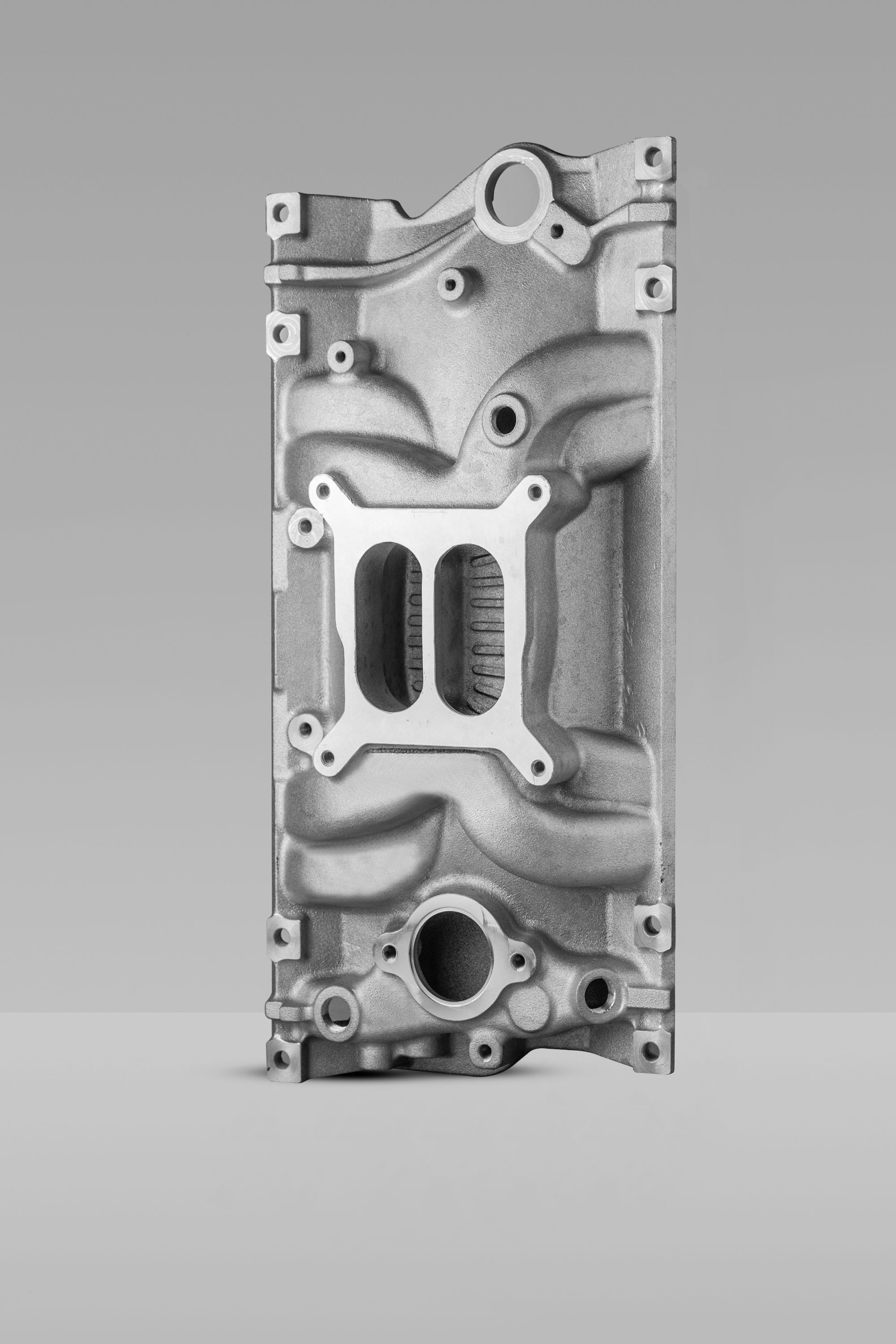
Real numbers matter more than promises. Every custom intake manifold we build begins its life on a flow bench, not just in a CAD model. The bench doesn't care about brand loyalty or marketing gloss — it measures velocity, turbulence, and cylinder-to-cylinder distribution with cold precision. If a runner shape looks aggressive but stalls at 0.500" lift, it gets reshaped before it ever reaches a customer's engine bay.
A recent order for a high-rpm road race engine illustrates why this process can't be skipped. The initial design flowed well on paper but showed a 7% imbalance between the center and end runners on the bench. Tapering the plenum entry and adding a subtle radius to the runner dividers brought the spread under 2%, while gaining 4 cfm at peak lift. No simulation predicted that exact fix — the bench did.
That's the quiet proof behind every order. We don't ship a manifold until its flow map matches the intended powerband, idle quality, and throttle response. The flow bench isn't a sales tool; it's a ruthless editor that removes guesswork from the equation.
Where Custom Runner Lengths Solve Real Driving Problems
Most scraping happens at the exact spot where a driveway meets the road or where a garage floor rises into a ramp. A stock-length runner often ends just short of that contact point, leaving the bumper or exhaust to take the hit. By measuring the actual distance from the front axle to the lowest overhang, a custom runner can extend a few inches further and hold the chassis off the pavement before the worst angle arrives.
The same logic applies to rough two-tracks and rock ledges. A short wheelbase rig climbing a sharp shelf will hang on a full-length runner that a longer pickup would clear. Trimming the front runners to match the tire’s contact patch and the suspension’s full droop lets the truck slide over the edge instead of balancing on its belly. On the rear, a longer runner can protect a low-hanging fuel tank or spare tire when dropping into a washout.
Towing and loading compound the problem because the rear squats and the effective departure angle shrinks. A trailer hitch or rear bumper that clears at street height can catch hard on a job site ramp before the suspension settles. Custom runner lengths mapped to the loaded ride height—not the empty brochure number—turn a noisy scrape into a quiet slide, and they keep repair costs off the tailgate, exhaust, and trailer wiring.
One Manufacturer’s Honest Take on Cast vs. Billet Custom Parts
If you ask a room full of machinists which is better, cast or billet, you'll get a lot of strong opinions and very few straight answers. The truth is, both methods have their place, and choosing the wrong one for your application will cost you either strength or money. I've spent years making custom parts for everything from race cars to industrial machinery, and the real difference comes down to what you're asking the metal to do.
Cast parts start as liquid metal poured into a mold, so you can create complex internal shapes and save material where you don't need it. But that same process introduces porosity and inconsistent grain structure. On a high-stress bracket or a suspension arm, that hidden void becomes a crack waiting to happen. Billet, cut from a solid block of forged or rolled stock, has a uniform grain flow that follows the machining path. It's denser, tougher, and far more predictable under load, which is why I'll never put a cast steering knuckle on a car I care about.
The catch is cost and waste. Billet machining can turn 80% of a perfectly good block into chips, and that hurts. For low-volume or one-off parts where strength matters, the billet premium is worth every penny. But for a decorative cover or a non-structural housing, a well-designed casting will do the job at a fraction of the price. The honest answer isn't which process wins, it's which process matches the part's actual job.
How Custom Flange Angles Prevent Fitment Headaches
Off-the-shelf flanges often assume a perfect mounting surface, but real-world installations rarely work that way. When pipes, panels, or mating components sit at even a slight offset, a standard 90-degree flange forces the installer to choose between over-tightening, adding shims, or accepting a stressed joint that may leak or crack later. Custom flange angles eliminate this guessing game by matching the exact angular relationship between two surfaces. Instead of fighting the hardware, the part arrives ready to seat flush, reducing the time spent on alignment and rework.
The practical benefit shows up most clearly in tight spaces where access is limited. A custom-angled flange can be designed to point a connection away from an obstruction, or to bring two offsets into a clean, straight run. This removes the need for multiple adapter fittings that introduce additional leak paths and pressure drops. Since the angle is machined into the flange body itself, the final assembly has fewer joints, better load distribution, and a cleaner appearance than a stack of wedges and washers.
For teams that deal with repeated fitment issues across similar builds, moving to custom angles also simplifies inventory and documentation. Rather than tracking a mix of universal flanges, shim kits, and special bolts, each position gets one part with a single torque specification. That consistency makes future maintenance easier and reduces the chance of a well-meaning technician swapping in the wrong combination under time pressure.
The Heat Soak Difference Most Buyers Overlook
When you take a test drive, the engine is usually warm but not heat-soaked. You accelerate, brake, maybe push it a little, and everything feels responsive. What you don't experience is what happens after you park that car for twenty minutes on a hot day, then start it up and merge onto a highway. That's when heat soak sets in—the engine bay temperature spikes, intake air gets hotter, and the ECU pulls timing to protect itself. The result is a noticeable dead spot in the throttle, sluggish acceleration, and sometimes even a stumble off idle. Most buyers never push a car hard enough during a short test drive to trigger this, so they overlook a difference that becomes glaring in daily summer traffic.
Not all cars handle heat soak the same way, and the engineering choices behind that difference rarely show up on a spec sheet. A well-designed intercooler with proper airflow, heat-reflective shielding around the intake path, or a fuel system that keeps rail temperatures stable can make a night-and-day difference. Some manufacturers deliberately mount the turbocharger lower or add auxiliary coolant pumps that keep circulating after shutdown. Others cut corners with thin heat shields and plastic intake manifolds that soak up heat like a brick. The irony is that two cars with nearly identical horsepower numbers on paper can feel completely different after a hot restart—one snaps to attention, the other feels like it's breathing through a straw.
If you're seriously comparing vehicles, don't just rely on a fifteen-minute loop around the dealership. Ask to take the car out after it has been sitting in the sun for a while, or better yet, drive it hard for ten minutes, park it, wait ten minutes, then start it again and pay attention to the first few seconds of throttle response and how the transmission behaves under light load. You can also research long-term owner forums for complaints about heat-related power loss—words like "heat soak," "hot restart," or "summer sluggishness" will surface quickly. That's where the real differences hide, and once you notice them, you'll never buy a car without checking for it again.
FAQ
Factory manifolds are usually designed for quiet operation, low cost, and packaging constraints. A custom manifold removes those compromises. You get runner lengths and plenum volume matched to your camshaft, cylinder head flow, and intended rpm range. That means more usable power where you actually drive or race, not just a peak number on a dyno sheet.
Runner length shifts the torque curve. Longer runners tend to boost low- and mid-range torque, while shorter runners favor top-end horsepower. If you shorten the runners too much, you might gain peak power but lose drivability. The key is matching the length to your engine's displacement, induction setup, and gearing. A quality manufacturer will ask about your specific setup rather than selling a one-size-fits-all manifold.
Not at all. A well-designed custom manifold can help a street engine breathe better at part throttle, improve throttle response, and even make highway cruising smoother if the runner length is chosen correctly. The benefit is more about matching the manifold to the engine's actual operating range than chasing maximum horsepower.
A top shop will have experience with your engine family, access to flow bench data, and a willingness to discuss your exact combination. They also tend to use proper fixturing during welding to avoid warping, pressure test each unit, and offer consistent port alignment. Cheap copies often skip those steps, which leads to leaks, uneven runner lengths, or cracked welds over time.
Not necessarily. Billet is great for precise, repeatable shapes and can be a good choice for low-volume or one-off pieces, but it's often heavier and more expensive. A high-quality fabricated manifold using formed runners and sheet aluminum can be lighter and flow just as well if the joints are clean. The material matters less than the design and welding quality. A good manufacturer will tell you when billet is actually needed and when it's overkill.
It can, but it depends on the rest of the tune. A manifold that keeps air velocity high at part throttle will make the engine feel crisper and can improve mixing in the cylinder. That often translates to slightly better fuel economy during normal driving. But if you're also changing camshafts or pushing the engine harder, those gains might be offset. The manifold alone won't fix a bad tune.
If you've already upgraded the cam, heads, or forced induction and the stock manifold is becoming a restriction, that's a strong sign. Also, if you're spinning the engine well past the factory redline, or if you're running a turbo or supercharger with a manifold not designed for boost, a custom piece can solve packaging and flow issues. A good manufacturer will be honest enough to tell you if the stock manifold is still fine for your goals.
Durability and repairability. Aluminum can handle higher boost pressures without cracking like plastic, and if something does crack or you need a change, a skilled fabricator can weld and modify it. That's much harder with cast plastic or composite manifolds. Plus, aluminum dissipates heat well, which helps keep intake air temperatures more stable.
Conclusion
A leading aluminum intake manifold maker recently laid out why they've moved away from recommending ordinary shelf parts. For years, they watched customers fight with compromises—port mismatches, awkward throttle positioning, and runner lengths that worked fine on a dyno sheet but felt dead on the street. That's why they now start every serious project with flow bench testing. A custom manifold isn't just a pretty weld job; it's a part shaped by actual airflow numbers. One of their engineers put it plainly: if you know an engine spends most of its time between 3,000 and 5,500 rpm, you design runner lengths for that range. Short runners for a high-revving track car, longer ones for a truck that needs mid-range grunt. Off-the-shelf castings simply can't offer that kind of targeted response.
They were also refreshingly candid about cast versus billet. Billet makes sense for one-off race pieces where you want to tweak the design between events, and the surface finish is easier to keep consistent. But a well-engineered cast manifold can drop weight and cost without giving up flow, especially when you're building several identical units. Another overlooked advantage is custom flange angles. A few degrees of tilt on the throttle body flange often spells the difference between a clean install and a hood clearance nightmare. Then there's heat soak. Most buyers obsess over peak horsepower and ignore how the manifold behaves after twenty minutes in traffic. Custom wall thickness and runner placement let you manage heat far better than any generic casting. That's the real reason these shops keep pushing custom work—not for show, but because each decision solves a problem you'd otherwise live with.
Contact Us
Contact Person: Shelly
Email: [email protected]
Tel/WhatsApp: 8613967667688
Website: https://www.yongyu.com/