

Calender Machine Company: Engineering Precision Calendering Solutions for Industry
2026-09-30
Precision calendering is the quiet backbone of countless industrial products—from rubber sheets to specialty films—yet the difference between a good calender and a great one often comes down to engineering nuance. That’s where SFC stands apart: we don’t just build calender machines, we engineer them around your exact material and throughput demands. In this post, we’ll break down what truly defines a high-performance calendering solution and why manufacturers are turning to SFC’s approach to stay ahead.
The Nip Pressure Sweet Spot: How We Help You Find It and Hold It
Nip pressure is one of those variables that looks simple on a spec sheet but behaves differently once the rolls are warm, the line speed changes, or the material isn't perfectly uniform. Too much pressure and you crush the web, create edge wear, or accelerate roll covering fatigue. Too little and you lose traction, invite wrinkling, or let moisture and air get trapped where they shouldn't. The sweet spot isn't a fixed number—it's a narrow band that shifts with each run, and finding it usually means chasing a moving target.
We take a different approach than thumbing through a generic chart or copying last month's settings. First, we map the actual contact footprint under load using pressure-sensitive film or real-time nip width sensors, not just calculated crown or hydraulic force. Then we correlate that footprint with what the web is telling us: caliper variation, moisture profile, coating weight, and any history of wrinkling or sheet breaks. From there we dial in a baseline pressure that's just enough to maintain uniform contact without flattening the sheet beyond spec. It's a bit slower than guessing, but it prevents the kind of invisible damage that shows up as quality complaints three shifts later.
Holding the sweet spot is where most systems fall short. Temperature swings, roll grind drift, and bearing wear can all push you out of the good zone within hours. So we install continuous monitoring that watches nip width, load imbalance, and vibration signature together. When the pattern starts to wander, you get a clear adjustment window—not an alarm storm. And if you're running a grade change or a trial material, we'll help you pre-calculate a safe starting point and then fine-tune in real time until the footprint is clean and symmetric. The goal isn't perfection on the first pull; it's making sure you can return to the sweet spot on demand, shift after shift.
What Precision Calendering Looks Like for Battery Films, Vinyl, and Rubber
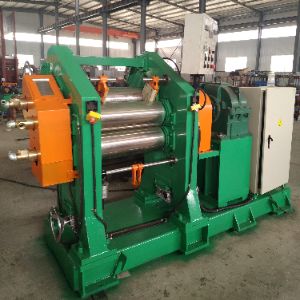
Precision calendering on these materials starts with a set of heated, hardened rolls that can be adjusted in tiny increments, often down to a few microns of gap change. The sheet emerges with a surface that mirrors the roll finish—whether that is a high-gloss polish for vinyl or a matte, controlled roughness for rubber. Web tension and roll temperature are constantly trimmed so the material does not neck down or develop edge beads.
Battery films push the process to its extreme. The polymer or composite layers run thinner than a human hair, and any pinhole, gel particle, or thickness drift becomes a potential short or capacity loss. Calendering lines here often operate in cleanroom conditions, with rolls polished to near-optical smoothness and automatic gauges feeding back to the gap controls every few seconds. The goal is not just a uniform sheet but a flawless dielectric barrier that stays consistent across thousands of meters.
Vinyl and rubber behave differently under the same nip. Vinyl benefits from a tight, repeatable gauge that keeps flooring or signage flat and easy to cut, while the roll surface can impart a specific sheen or embossed pattern. Rubber compounds, by contrast, need careful heat history—too much roll warmth scorches the stock, too little leaves it weak and porous. Skilled operators watch the bank between rolls, adjusting feed rate and temperature so the rubber sheets come out dense, smooth, and ready for curing or lamination without trapped air or cold flow defects.
Why Roll Deflection Control Matters More Than Roll Diameter
Many mill operators still focus on roll diameter as the primary lever for gauge control, but that mindset overlooks where the real variability comes from. Under load, a roll bends—not uniformly, but in a complex curve shaped by strip width, crown, and backup roll contact. That deflection can shift the loaded gap by tens of microns while the roll diameter stays exactly the same. So a larger roll doesn't automatically give you a more stable bite; it just moves the deflection pattern. What actually changes the strip profile is how well you counteract that bending moment, whether through roll crowns, bending cylinders, or shifting systems.
Deflection control also matters because it determines the shape of the contact patch between work roll and strip. Two rolls with identical diameters but different support setups can produce wildly different flatness results. If you ignore deflection and chase diameter alone, you end up adding mass and cost without solving edge-wave or center-buckle issues. The real question is: where is the neutral axis shifting under load, and what counter-force is being applied at the roll ends? Once you tune that, even a smaller roll can outperform a larger one in profile control.
A better way to think about it is that roll diameter sets the scale, but deflection control sets the precision. You can have a massive roll that bows and creates a heavy center, or a modest roll with active bending that holds a nearly flat profile across the strip. The distinction shows up in every coil—especially on wide, thin material where small deflections translate into large flatness defects. Rather than asking "how big should the roll be," ask "how flat is the gap under rolling force?" The latter question leads to better strip, better yield, and fewer hidden costs.
Custom Roll Stacks That Drop Into Your Existing Line Without Drama
Most retrofit projects come with a quiet worry: will this roll stack actually land where the old one sat, or will the floor crew spend a week making it fit? The answer sits in how the stack is drawn before it ever reaches your plant. Roll face widths, centerline heights, drive side positions, and even the angle of your existing threading path get baked into the design. That means no field cutting, no surprise spacers, and no last-minute call to the engineering desk because a bearing housing is off by half an inch.
What changes on install day is mostly what doesn't happen. You won't see a cutting torch or a crane swinging beams out of the way. The stack drops onto your existing mounting points, bolts align with the holes that are already there, and the drive connection matches the shaft you already have. The crew can focus on alignment and run-in instead of reworking the line around the new equipment. When adjustments do show up, they tend to be shims and turnbuckles, not re-engineered frames.
After start-up, the payoff shows in how normal everything feels. Tension runs the way operators expect, wrap angles were calculated for your specific web path, and the control touchpoints stay familiar. Nobody has to memorize a new set of quirks or write a new threading procedure from scratch. The new roll stack simply takes over the job, adds the capability you were missing, and leaves the rest of the line alone.
The Surface Finish Details That Stop Web Wrinkles Before They Start
Wrinkles rarely appear out of nowhere—they begin as tiny lateral shifts in the web, and the right surface finish stops that movement before it turns into a crease. A finely controlled roughness, often in the 0.8–1.6 µm Ra range, gives the roller just enough grip to hold the film without creating high spots that imprint or stretch it. The key is a non-directional, isotropic texture: unlike a polished mirror finish, it lets air escape at the nip instead of trapping it under the sheet, which is one of the most common hidden triggers of wrinkling.
On wider or thinner webs, a spiral groove or micro-grooved finish can work even better, because it breaks up the air boundary layer and channels it outward. The groove depth, pitch, and land area all matter more than the nominal roughness number; if the lands are too wide, the web rides on air, and if the grooves are too deep, they leave marks. Getting these details right means the web enters the next section with uniform tension across its full width—wrinkles never get the chance to form.
From Single-Nip Lab Units to Production Calenders Running Around the Clock
Early development work rarely leaves the bench. The single-nip lab unit is where material behavior first gets questioned under heat and pressure, with operators adjusting roll gaps by hand and logging every pass. It is slow, deliberate, and often frustrating, but it is also the only place to learn how a formulation responds before anyone spends money on scale-up.
Moving to a production calender changes the conversation entirely. The machine does not stop for tweaks; it expects the material to behave the same at two in the morning as it did at two in the afternoon. Operators who once relied on feel now watch closed-loop controls, and the real challenge becomes consistency across hundreds of meters rather than a single sheet on a lab bench.
Running around the clock introduces a different kind of discipline. Shift handovers turn into the weak link, where small changes in roll temperature or nip pressure get lost in verbal notes. The best plants treat the calender as a continuous experiment, with data logged every shift so that the lessons from that first single-nip unit never get buried under production targets.
FAQ
We engineer precision calenders and complete calendering lines for industries that need exact thickness, surface finish, or material densification.
Rubber, plastics, textiles, paper, battery electrode production, and composites, anywhere roll gap control matters.
We use precision ground rolls, temperature-controlled designs, and servo-hydraulic gap adjustment with real-time monitoring.
Yes, we adapt roll materials, heating/cooling, and nip forces to the specific polymer, elastomer, or coated substrate.
Yes, we provide commissioning, operator training, roll refurbishment, and process troubleshooting.
We start from the material behavior and end product target, then engineer the roll stack, drives, and controls around that rather than forcing a standard frame.
We review your throughput, width, and tolerance goals, then propose a layout and control architecture, iterating with you before build.
Yes, we can upgrade drives, controls, cross-axis correction, or replace rolls to extend life and improve gauge uniformity.
Conclusion
At Calender Machine Company, we don't just build rolls that squeeze material—we engineer the exact nip pressure profile your product demands, then hold it there run after run. Whether you're coating battery electrode films, polishing vinyl to a mirror finish, or laminating rubber with tight gauge tolerance, our approach starts with understanding how roll deflection, not just diameter, changes the contact line under load. By sizing crown, adjusting roll bending, and choosing surface treatments that actually make sense for your chemistry and speed, we help you hit that sweet spot where quality and throughput stop fighting each other.
What sets our work apart is how easily it drops into what you already run. You don't need to rip out your line to get better calendering—we design custom roll stacks, from single-nip lab units for proving out new films to full production calenders that never sleep, around your existing frame, drives, and unwinds. That means less downtime, fewer surprises during startup, and a finish detail—right down to the micro-texture that stops web wrinkles before they form—that keeps your operators smiling instead of chasing defects. Calender Machine Company gives you the precision you can feel in the final roll, not just in the spec sheet.
Contact Us
Contact Person: Chen Zhengwei
Email: [email protected]
Tel/WhatsApp: +86-13963975727
Website: https://www.sfcrubbermachine.com